 English
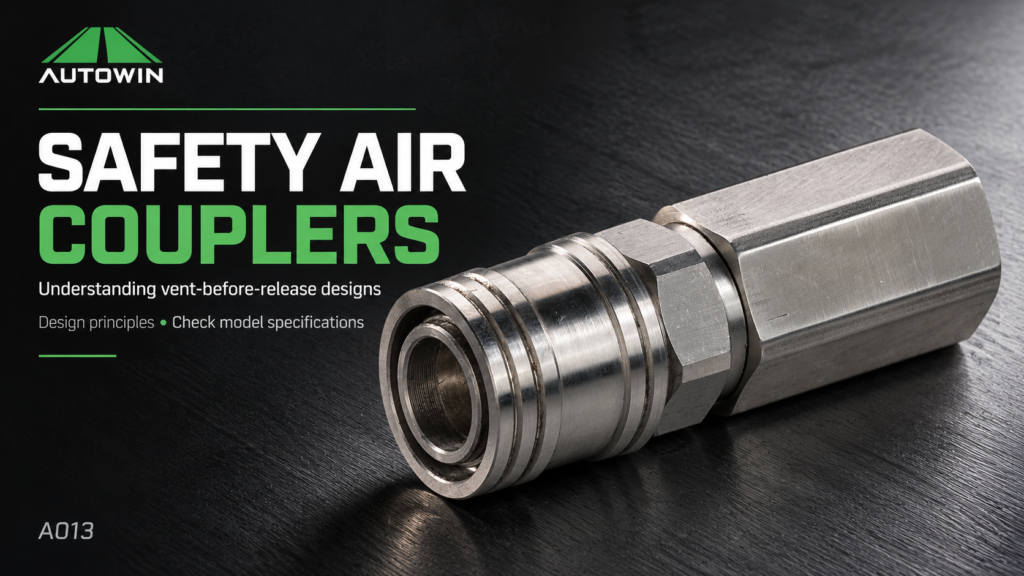
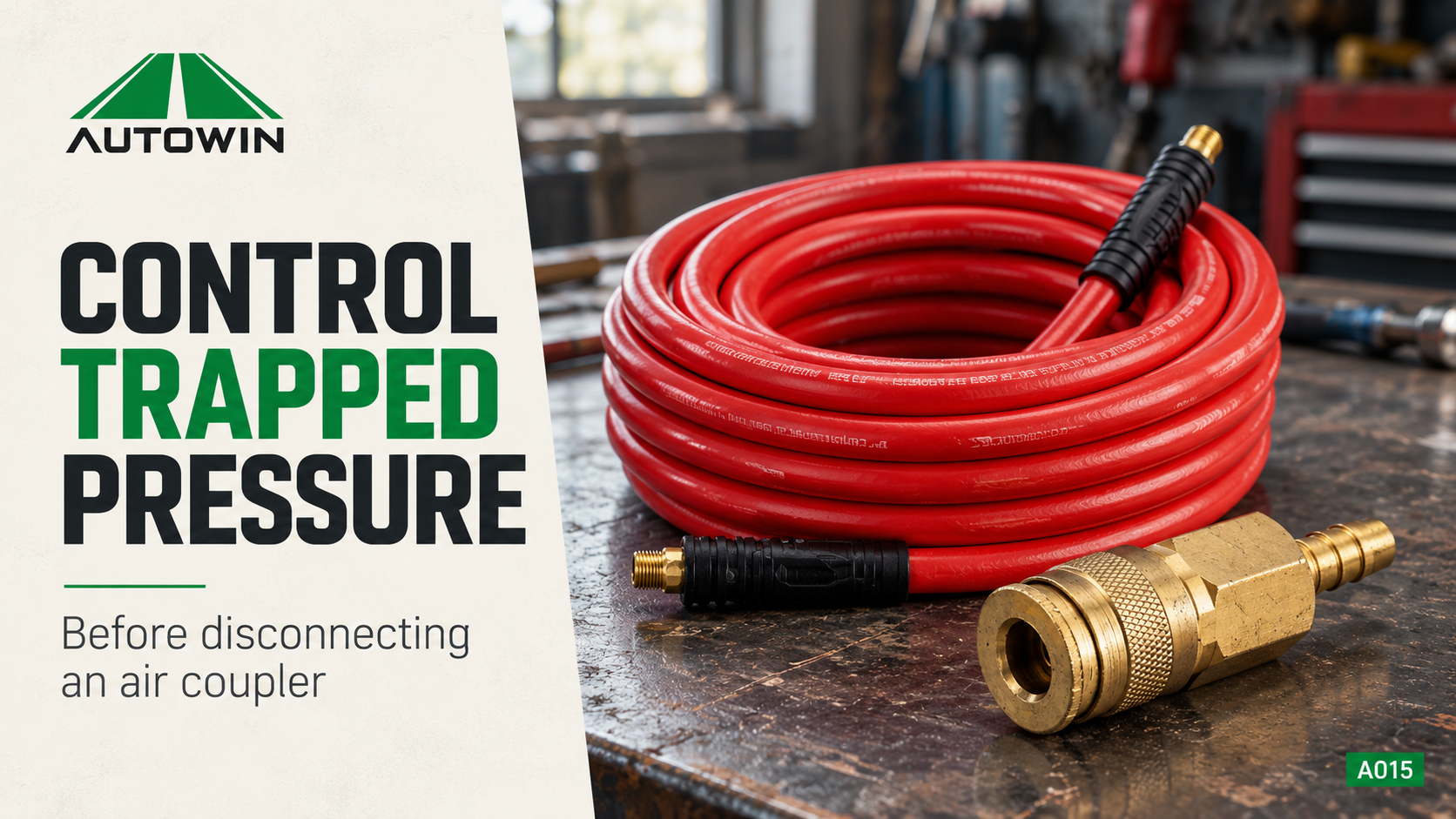
A safety air coupler with a vent-before-release function reduces pressure on the connector side while the plug is still retained. Release follows the sequence specified for that coupling. This is the feature to verify when selecting quick disconnect air fittings for a workstation where a charged hose could recoil during a changeover.
The word “safety” alone does not describe the mechanism. A sleeve lock, an exhaust stage and an excess-flow valve perform different jobs. For a purchasing specification, state what must happen to the air and to the plug at each stage. Start with the air hose fittings selection guide if the connection profile or hose arrangement is still undecided.
Follow the pressure path before comparing the sleeve
During normal operation, the connected assembly supplies air to the downstream hose or tool. A venting coupling adds a controlled transition between that operating state and separation. The relevant question is whether its design exhausts the connected downstream volume before allowing the plug to leave.
Festo describes NPHS sockets as exhausting air on the connector side without releasing the coupling. Its metal and polymer sleeve versions have different operating descriptions. CEJN describes eSafe as venting before disconnection. These examples establish a shared functional aim, but they do not establish a universal sleeve movement, waiting time or operating procedure for every manufacturer.
Do not specify an arbitrary pause such as “wait two seconds.” The required procedure and any indication that release is permitted belong in the selected product’s instructions. Downstream components may also isolate volumes that the coupling cannot vent.
A matching plug can change the result
One unusually useful detail appears on page 2 of the supplied Festo NPHS catalogue: combining a KD4 socket with an NPHS-S6 plug does not provide the safety function. Festo states that this combination releases the plug directly in one step. The same page limits the polymer-sleeve NPHS-D6-P socket to hardened NPHS-S6 plugs.
The purchasing implication is specific: compatibility must include the intended function, not just the ability to mate. Record both part numbers and the approved combination. A substitute plug should trigger a review of the release function as well as fit, sealing and retention. Our universal air coupler compatibility guide explains why a broad interchange label still needs a defined compatibility list.
Build a functional comparison sheet
| Item to compare | Evidence to request | Purchasing decision |
|---|---|---|
| Release sequence | Instructions showing retention, exhaust and release | Approve the specified sequence for the workstation |
| Mating combination | Socket and plug codes, profile and size | Keep the approved pair on the bill of materials |
| Operating conditions | Pressure, temperature, medium and seal limits | Match the actual circuit conditions |
| Flow performance | Flow data with inlet pressure and pressure drop | Compare under equivalent conditions |
| Replacement control | Approved alternatives and identification method | Prevent undocumented substitutions |
A low-profile body or attractive sleeve does not answer these questions. Nor does a high pressure rating prove that a coupling can be separated under any pressure condition. The air coupler specification checklist helps keep working pressure, flow and connection dimensions in separate fields.
What to review with an OEM manufacturer
For OEM air couplers, send the intended mating parts, installation orientation, hose dimensions and operating conditions together. Ask the manufacturer to identify the proposed release mechanism and the exact configurations covered by its documentation. Where a compliance statement is needed, request evidence for the offered product and configuration; a statement in another brand’s catalogue cannot be transferred to it.
Use a sample review to answer a defined question. For example, can the operator access the control while wearing the required gloves, and does the supplied instruction match the delivered part? Functional acceptance testing should follow an agreed procedure with suitable equipment and competent personnel. A showroom demonstration or an audible click is not a substitute for that assessment.
Wholesale air fittings also need consistent replenishment. Keep the socket and approved plug identifiers on packaging and purchase records, and document changes to suppliers or versions. This makes a repeat order reproducible instead of relying on sleeve colour or appearance.
Questions buyers ask
Does every safety air coupler need two separate hand movements?
No. The pressure-release stages and the operator’s movements are not the same thing. Follow the instructions for the exact model; do not infer the sequence from a product photograph.
Can a safety plug upgrade an ordinary socket?
Do not assume so. The Festo KD4 and NPHS-S6 example shows that a mating combination can lack the intended safety function. Obtain written confirmation for both halves.
Does a venting coupling make the entire machine pressure-free?
No. It addresses the volume connected to its exhaust path. Check valves, closed valves or other components can isolate pressure elsewhere. Machine servicing requires the applicable energy-isolation procedure.
Specify the function before requesting a quotation
Explore AUTOWIN’s pneumatic quick connect fittings and send the required mating profile and release behaviour with your enquiry. For an OEM coupling project, include the operating conditions and the documents required for approval. The proposed model’s safety function must be confirmed during selection.
Download this guide
Keep the complete guide, comparison table and technical references for your next specification review.
Download PDF (4 pages · 3.5 MB)
Related reading: connection operation and pressure control
Technical references
- Festo NPHS catalogue, physical PDF pages 2–5: operating principle, permitted combinations and model-specific technical data.
- CEJN eSafe brochure, physical PDF pages 4–5: vent-before-disconnection principle. Brand examples describe those products, not AUTOWIN test results.