 English
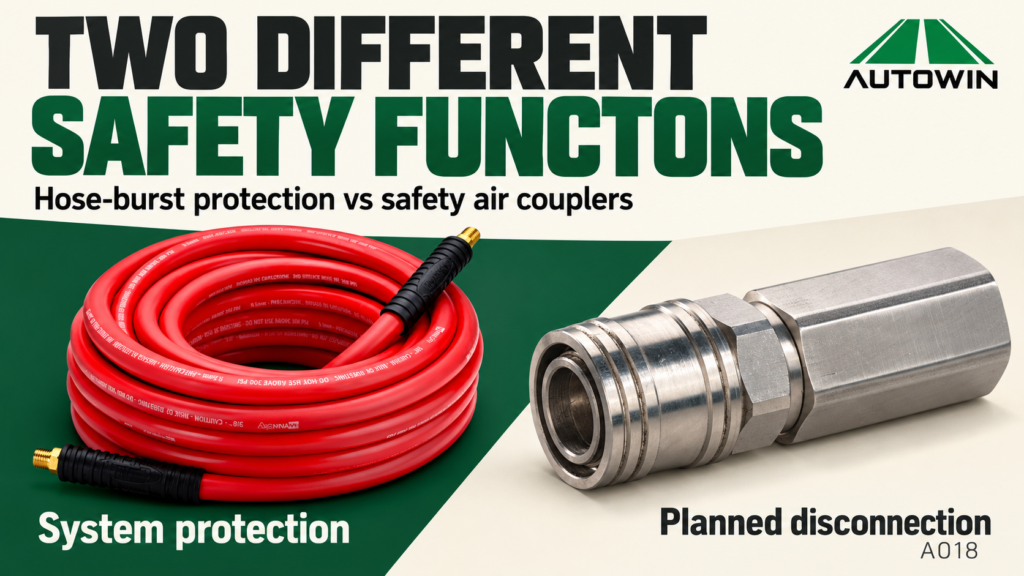
Hose-burst protection and a safety air coupler address different events. An excess-flow device responds when the flow-related pressure differential reaches its operating threshold. A vent-before-release coupling manages downstream air during an intentional disconnection. One should not be specified as a substitute for the other without reviewing the actual circuit and required protective function.
Both can appear among compressed air fittings or air hose attachments, but a shared “safety” label is not a functional specification. Identify the event you need to control before choosing the device.
Compare the event that activates each function
| Question | Excess-flow hose protection | Vent-before-release coupling |
|---|---|---|
| What event is addressed? | A flow condition associated with a downstream failure | A planned separation at the coupling |
| What initiates the action? | The specified flow-related pressure differential | The coupling’s release operation |
| What must be selected? | Size, direction and cutoff characteristics for the circuit | Profile, approved mate and documented release function |
| What does the label not establish? | Detection of every leak or failure | Protection against a hose rupture elsewhere |
| What evidence is needed? | Operating data and installation instructions | Pairing data and operating instructions |
This comparison is a way to structure a system review. It does not prescribe a layout or establish that a particular combination satisfies a site’s requirements. The complete arrangement needs assessment against the equipment, operating conditions and applicable requirements.
What the supplied SCV catalogue actually says
Dixon’s SCV-Series explanation on physical PDF page 70 describes a spring-and-valve assembly operated by the pressure differential across the device. Below its cutoff condition, the spring keeps the valve open. Above that condition, the differential force closes it. The catalogue relates the differential to air flow.
The same page states that the SCV-Series does not prevent backflow. It also explains that pressure equalization through a bleeder hole enables automatic return to normal operation after the problem is repaired. These details distinguish this device from an ordinary non-return valve and from an isolation valve intended to secure a maintenance boundary.
Its limitations matter as much as its operating principle. Dixon does not recommend that series for applications requiring all the available air supply, and recommends auxiliary protection as appropriate. Those statements belong to the documented series; do not assume another product has identical limits or reset behaviour.
A small leak may never reach the cutoff condition
A threshold-operated device can only respond when its operating condition is reached. It follows that a leak below that condition cannot be assumed to trigger the device. This is an engineering implication of the described mechanism, not a claim that a particular installation has been tested.
Selection must consider normal operating demand and the possible failure-flow condition. If the chosen threshold is inappropriate, the protective function may not behave as intended in that circuit. Thread size alone does not provide that information.
Ask the supplier for the conditions associated with the cutoff data and the allowed installation direction. Provide the hose arrangement and normal operating demand for review. Do not set a cutoff value from an online table without checking that the listed conditions apply.
A safety coupling manages a different pressure transition
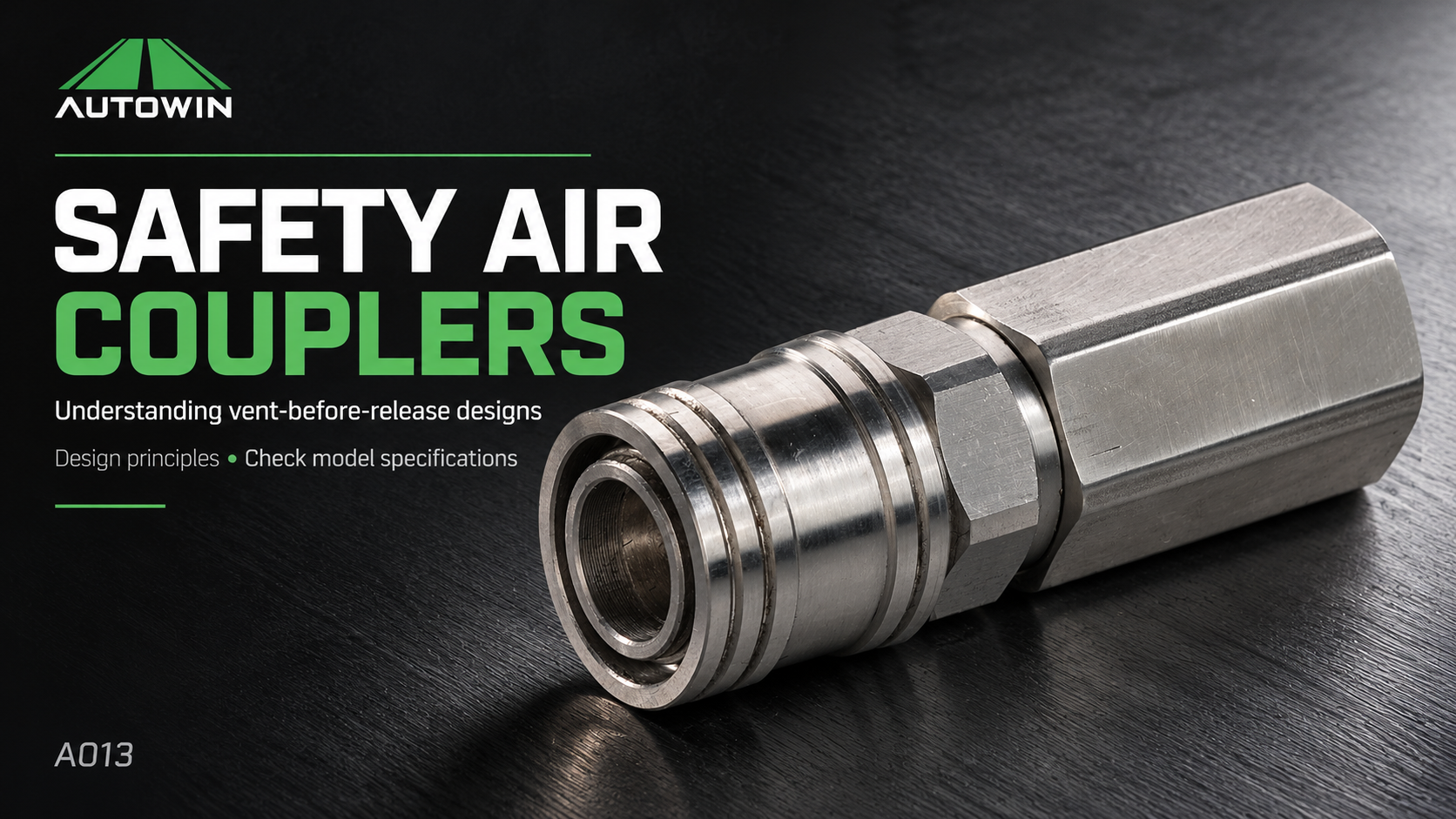
The supplied Festo NPHS and CEJN eSafe documents describe exhausting the connector side before the plug is released. This addresses the pressure transition at a planned disconnection. It does not establish that the coupling detects a rupture further along the hose.
A useful circuit sketch therefore marks the intended disconnection point separately from the location and coverage of any excess-flow device. It also identifies isolation and exhaust arrangements for servicing. Treat each function as a separate requirement and confirm how the components interact.
Before defining that sketch, use the air hose fittings guide to establish the connection system. The coupler specification checklist helps keep pressure ratings and flow conditions distinct.
Questions for an industrial supplier
For OEM compressed air systems, describe the operating event you want to manage: normal changeover, excessive downstream flow, reverse flow or maintenance isolation. Ask the industrial air fitting supplier to identify which function each proposed component actually provides.
Request the relevant part number, permitted medium, pressure and temperature limits, direction requirements and operating instructions. For an excess-flow device, include the cutoff characteristics and reset information. For a venting coupling, include the approved plug list and release sequence. Record unanswered items instead of interpreting a generic catalogue heading as confirmation.
For wholesale pneumatic components, retain those distinctions in stock descriptions and replacement guidance. A colour change or a similar body is not evidence of equivalent protection. Our guide to coupling compatibility explains how to control mating-part substitutions.
Frequently confused functions
Is a hose-burst device just a check valve?
No. The SCV example responds to flow-related differential pressure, and its manufacturer explicitly states that it does not prevent backflow. Read the actual function rather than relying on the word “check.”
Will it stop every air leak?
That cannot be assumed. A threshold-operated device needs its operating condition to be reached. It is not a general leak-detection system.
Can I use its closed state as maintenance isolation?
Do not assume so. The documented SCV example includes a bleed path and automatic reset behaviour. Apply the equipment’s approved isolation and stored-energy procedure for service.
Does a venting coupler protect a hose that bursts during use?
Venting before planned release is a different function. Any required failure-flow protection must be selected and documented separately.
Browse AUTOWIN’s air coupling range for connection options. For an OEM technical enquiry, provide the circuit sketch and requested functions so the offered components and documentation can be reviewed. Product availability and protective capabilities require confirmation for the proposed model.
Download this guide
Keep the complete guide, comparison table and technical references for your next specification review.
Download PDF (4 pages · 2.9 MB)
Related reading: connection operation and pressure control
Technical references
- Dixon 2026 Quick Coupling Catalog, physical PDF page 70: SCV operating principle, backflow limitation, bleed path and application restrictions.
- Festo NPHS catalogue, physical PDF page 2, and CEJN eSafe brochure, physical PDF page 5: vent-before-release examples.